


 English
 русский
 Español
 عربى

Product Series
Product Category
- Traffic Signal Light
- Crosswalk Signal Light
- Solar Signal Light
- Traffic Signal Light Source
- Road Monitoring Pole
- Road Signs
- Road Signs Pole
- LED Traffic Guidance Screen Pole
- Highway Electronic Screen Frame
- Intelligent Traffic Camera Column
- Multifunctional Combination Lamp Pole
- Solar Road Lamp
- Smart Streetlights
Contact us
 +86-18052558887

 About Us
A Manufacturer Focused on Road Infrastructure Products
As China Solar Powered Traffic Signal Manufacturers and Solar LED Traffic Signal Light Suppliers, with experience in manufacturing products for road traffic management, traffic safety, and roadway lighting, we support customers with project-based sourcing and customized procurement requirements.
Yongyao is more than a product supplier. We aim to be a reliable manufacturing partner that understands the practical requirements of each project.
For contractors, distributors, and engineering procurement companies, this means more efficient and reliable coordination—from requirement confirmation and product customization to production and delivery.
 Supporting Standard Supply and Custom Production
Supporting Standard Supply and Custom Production
Supporting Standard Supply and Custom Production
News
Stay Updated on Our Latest News and Exhibitions





Solar Signal Light Manufacturer for Off-Grid Road Infrastructure
Yangzhou Yongyao Traffic Lighting Co., Ltd. specializes in the manufacturing and supply of advanced Solar Signal Light systems designed for a wide range of traffic management, road safety, industrial transportation, and infrastructure applications. As a China-based manufacturer of solar-powered traffic lighting equipment, Yangzhou Yongyao Traffic Lighting Co., Ltd. provides practical lighting solutions for locations where conventional grid electricity is expensive, difficult to access, or unsuitable for the project environment. By integrating high-efficiency solar panels, rechargeable battery storage systems, energy-efficient LED signal heads, and dedicated control components, our Solar Signal Light products offer a flexible approach to traffic signaling without the need for extensive underground cabling or road excavation. Our product range serves intersections, suburban highways, rural roads, industrial parks, scenic routes, temporary construction zones, parking facilities, and other locations requiring reliable visual traffic guidance. With capabilities covering standard product supply and customized OEM/ODM manufacturing, Yangzhou Yongyao Traffic Lighting Co., Ltd. works with distributors, engineering contractors, traffic equipment suppliers, and infrastructure developers to provide Solar Signal Light solutions that match project layouts, installation requirements, operating schedules, and environmental conditions.
Advanced Solar Signal Light Technology and System Integration
Yangzhou Yongyao Traffic Lighting Co., Ltd. develops Solar Signal Light systems around the efficient conversion, storage, and utilization of solar energy. A typical system incorporates a photovoltaic solar panel, a rechargeable battery bank, LED signal heads, a charge controller, electrical protection components, and supporting mounting structures. During daylight hours, the solar panel converts available sunlight into electrical energy, which the charging system manages and stores in the battery for subsequent operation. The stored energy powers the signal heads during nighttime hours and periods of reduced sunlight, subject to the selected battery capacity, panel configuration, signal duty cycle, and local weather conditions. This integrated design provides an alternative to conventional traffic signals that depend entirely on a permanent grid connection. Yangzhou Yongyao Traffic Lighting Co., Ltd. can configure Solar Traffic Signal Light assemblies according to project-specific power requirements, installation locations, signal operating patterns, and maintenance preferences. By selecting appropriate panel dimensions, battery specifications, LED modules, and control arrangements, our manufacturing team can support different performance targets without requiring every project to use an identical configuration. For projects involving remote intersections or isolated road sections, a Solar Powered Traffic Signal can reduce dependence on utility infrastructure and help simplify electrical installation planning. Our Solar LED Traffic Signal Light solutions also utilize LED technology to provide visible signal indications with comparatively low power consumption, allowing the available solar energy to support extended operating periods when the complete system is properly designed and maintained.
Applications Across Intersections, Highways, and Industrial Facilities
Yangzhou Yongyao Traffic Lighting Co., Ltd. supplies Solar Signal Light products for traffic management scenarios with different installation constraints and operational demands. At road intersections, a Solar Signal Light can provide red, yellow, and green indications where extending the electrical grid would involve substantial civil works or complicated utility coordination. For suburban highways and rural road junctions, solar-powered signaling equipment can offer a practical option for improving traffic guidance in locations far from existing electrical infrastructure. Industrial parks, logistics centers, factory entrances, and warehouse access roads may also benefit from a Solar Traffic Signal Light designed to manage vehicle movements, control entry and exit points, and support safer interaction between vehicles and pedestrians. At construction sites, temporary traffic diversions and changing work-zone layouts can create a need for signal equipment that is comparatively easy to install, relocate, and reconfigure. Yangzhou Yongyao Traffic Lighting Co., Ltd. can manufacture Solar Powered Traffic Signal products for these temporary applications, with the final configuration determined by the required signal sequence, installation method, environmental exposure, and operating duration. Scenic roads, tourist destinations, agricultural access routes, and remote service roads represent additional potential applications. In locations where trenching or cable laying could disturb existing pavement, landscaping, drainage systems, or protected surroundings, a Solar LED Traffic Signal Light can reduce the need for extensive electrical infrastructure. Each application requires appropriate consideration of traffic volume, road geometry, visibility, pedestrian activity, local regulations, and expected sunlight availability. Yangzhou Yongyao Traffic Lighting Co., Ltd. supports project planning by offering product configurations that can be evaluated against these practical site requirements.
High-Efficiency Solar Panels and Reliable Battery Storage
The photovoltaic panel and battery bank directly influence the operating capability of a Solar Signal Light system. Yangzhou Yongyao Traffic Lighting Co., Ltd. selects system configurations according to expected energy consumption, available sunlight, daily operating hours, seasonal weather variation, and the required reserve capacity. Solar panel output must be sufficient to replenish the energy consumed by the signal heads and control components under the intended operating conditions. Battery capacity must also accommodate nighttime operation and periods of limited solar charging, while the charge controller helps regulate charging behavior and protect the energy storage system within its specified operating limits. Depending on the selected design, battery chemistry, installation environment, and maintenance strategy, different storage configurations may be suitable for individual projects. Yangzhou Yongyao Traffic Lighting Co., Ltd. can assess customer requirements when developing a Solar Traffic Signal Light with a suitable balance between panel capacity, battery storage, enclosure dimensions, and total system cost. For areas experiencing frequent rain, seasonal cloud cover, dust accumulation, or temperature fluctuations, the energy system should be sized with realistic assumptions rather than relying exclusively on ideal sunlight conditions. Our Solar Powered Traffic Signal configurations can be specified around the expected load and local solar resource, helping project planners establish reasonable operating expectations. Battery condition, panel cleanliness, mounting orientation, shading, and charging performance should also be considered during routine inspections. Through appropriate component selection and system configuration, Yangzhou Yongyao Traffic Lighting Co., Ltd. aims to supply Solar LED Traffic Signal Light products that provide practical energy management and dependable operation within the limits of the chosen design.
LED Signal Heads, Visibility, and Traffic Guidance
Yangzhou Yongyao Traffic Lighting Co., Ltd. integrates LED signal technology into Solar Signal Light assemblies to support clear visual communication for motorists, pedestrians, and industrial vehicle operators. LED signal heads are available in configurations suited to different traffic-control requirements, including red, yellow, and green indications, directional arrows, and other specified signal displays. The appropriate optical design, signal diameter, lens characteristics, mounting height, and viewing orientation depend on the intended application and applicable traffic engineering standards. A well-configured Solar Traffic Signal Light should provide suitable visibility at the intended observation distance while maintaining an electrical load compatible with the available solar generation and battery capacity. Yangzhou Yongyao Traffic Lighting Co., Ltd. can work with customers to define signal colors, head arrangements, housing materials, and mounting interfaces according to project drawings and technical specifications. For remote road junctions, a Solar Powered Traffic Signal may offer a practical means of providing traffic indications without a permanent grid connection, provided the energy system and operating sequence are appropriately engineered. For projects requiring compact, energy-conscious signaling equipment, a Solar LED Traffic Signal Light can combine LED illumination with an integrated photovoltaic power supply. Actual visibility and signaling performance depend on factors such as ambient light, weather, lens condition, viewing angle, and installation geometry. Customers should specify the applicable photometric requirements and local compliance standards during the quotation and design stages. Yangzhou Yongyao Traffic Lighting Co., Ltd. can use these requirements as a basis for selecting suitable signal modules and preparing a product configuration for technical review.
OEM and ODM Manufacturing for Customized Traffic Projects
Yangzhou Yongyao Traffic Lighting Co., Ltd. provides OEM and ODM manufacturing services for customers seeking Solar Signal Light products under their own brands, according to their engineering drawings, or in accordance with project-specific technical documentation. OEM services can support the production of specified assemblies, including agreed housing dimensions, signal head arrangements, solar panel mounting structures, battery compartments, electrical interfaces, labels, and packaging. ODM services can support the development or adaptation of a product configuration based on the customer's intended application, operating conditions, and functional requirements. Customers may provide drawings, reference photographs, installation dimensions, electrical specifications, signal sequences, environmental conditions, and expected operating schedules to establish a clear manufacturing brief. Yangzhou Yongyao Traffic Lighting Co., Ltd. can then evaluate the requested Solar Traffic Signal Light design and identify the relevant component specifications, structural considerations, and customization options. For projects involving unusual pole dimensions, restricted installation spaces, distinctive signal layouts, or specific enclosure requirements, customized Solar Powered Traffic Signal assemblies may provide a better fit than standard catalog products. Brand identity requirements, including approved logos, product identification plates, documentation, and packaging artwork, can also be discussed during the OEM/ODM process. Yangzhou Yongyao Traffic Lighting Co., Ltd. encourages customers to confirm essential technical details before production, including electrical compatibility, mounting interfaces, expected energy consumption, and applicable certification requirements. This approach helps establish a more consistent basis for sample evaluation, production planning, and delivery coordination. For distributors and project integrators managing multiple road infrastructure orders, our customized Solar LED Traffic Signal Light manufacturing services can support product differentiation and alignment with the requirements of individual markets.
Our Solar Signal Light Range
We build solar signal products around the installation geometry, traffic flow and power autonomy required by each site. The range covers cantilevered vehicle signals, pole-mounted signal heads and integrated solar power assemblies.
Cantilevered Solar Traffic Lights
Single-arm structures that extend signal heads above traffic lanes. Suited to wide intersections and multi-lane roads where a pole-mounted head would be obstructed.
Pole-Mounted Solar Signal Heads
Compact solar-powered signal units for secondary roads, park entrances and temporary traffic control points.
Solar Power Assemblies
Panel, battery and charge controller packages sized to the signal load and local solar conditions, supplied with the signal structure or as a separate kit.
Each configuration is manufactured to match the pole height, arm length, signal head size and foundation requirements of the project. We confirm structural compatibility between the solar assembly, signal head and support pole before production.
Application Fit and Site Conditions
Solar signal lights are most effective where trenching and grid connection are impractical. Typical applications include suburban and rural intersections, internal roads in industrial parks, scenic area access roads, construction site traffic control and newly developed smart city sections.
- Suburban highways and rural roads: independent power supply avoids long cable runs and reduces construction cost.
- Industrial parks and logistics zones: relocatable signal assemblies suit phased development and temporary access points.
- Scenic and recreational areas: no trenching preserves road surfaces and landscaping.
- Construction and event traffic control: self-contained units can be repositioned as site layouts change.
Site shading from buildings, trees or terrain directly affects solar yield. We review panel orientation, mounting height and battery capacity against the required days of autonomy during overcast weather.
Technical Specifications and Configuration Options
Our solar signal lights are configured around verified component families. The table below shows the typical specification scope we manufacture and the variables confirmed during project review.
| System Element | Typical Scope | Project Variable |
|---|---|---|
| Solar panel | Monocrystalline or polycrystalline silicon, 160W–200W | Daily solar hours, panel orientation, shading |
| Battery bank | 12V/150Ah–200Ah gel or lithium, maintenance-free | Required autonomy during rainy or overcast periods |
| Signal light source | 10mm four-element ultra-bright LED, ≥400 cd | Lens size (300mm or 400mm), display type (full disk or arrow) |
| Pole and structure | Q235/Q355 steel, hot-dip galvanized, powder coated | Height, arm length, wall thickness, wind load |
| Controller | Smart charge/discharge controller with overcharge protection | Wireless synchronization or wired networking requirement |
| Enclosure protection | IP65/IP67 lamp housing and electrical enclosure | Coastal, dusty or high-humidity environment |
| Operating temperature | -40°C to +75°C | Local climate extremes |
Signal heads are available in 300mm and 400mm lens sizes with full-disk or arrow configurations. Wireless synchronization allows multiple directions at an intersection to switch together without control cable between poles.
Engineering and Customization Support
We manufacture from customer drawings, samples and technical specifications. For solar signal projects, customization typically covers pole height and arm length, panel mounting position, battery enclosure type, signal head arrangement and control logic.
- Structural coordination: pole diameter, wall thickness and base plate details matched to the cantilever load and local wind requirements.
- Power sizing: panel wattage and battery capacity selected for the signal load and required days of autonomy.
- Control integration: charge controller settings and signal controller interface confirmed against the project's traffic management scheme.
- Finish and protection: hot-dip galvanizing and powder coating for long-term outdoor exposure.
Our team evaluates manufacturing feasibility before quotation, including material availability, fabrication method and transport dimensions. Where a project requires coordination with other roadside structures, we can review the interface between the solar signal assembly and the supporting pole or foundation.
Quality Control and Acceptance
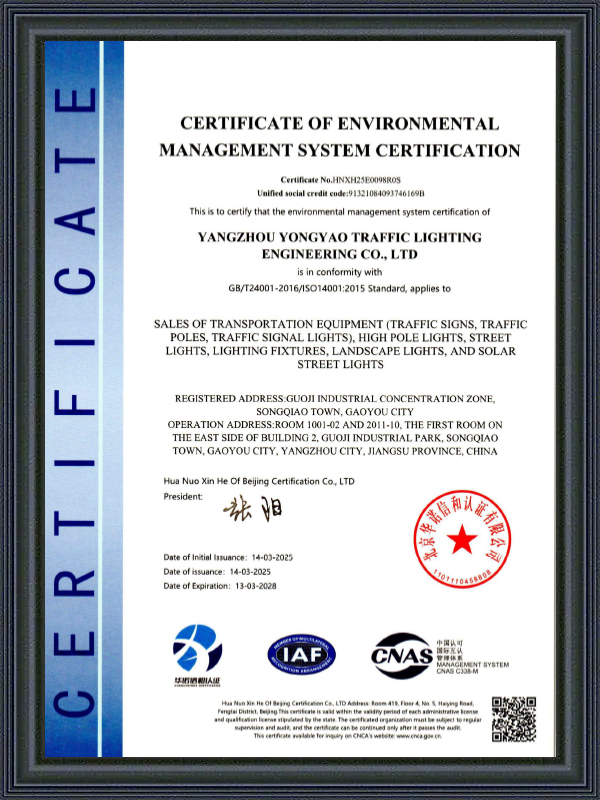
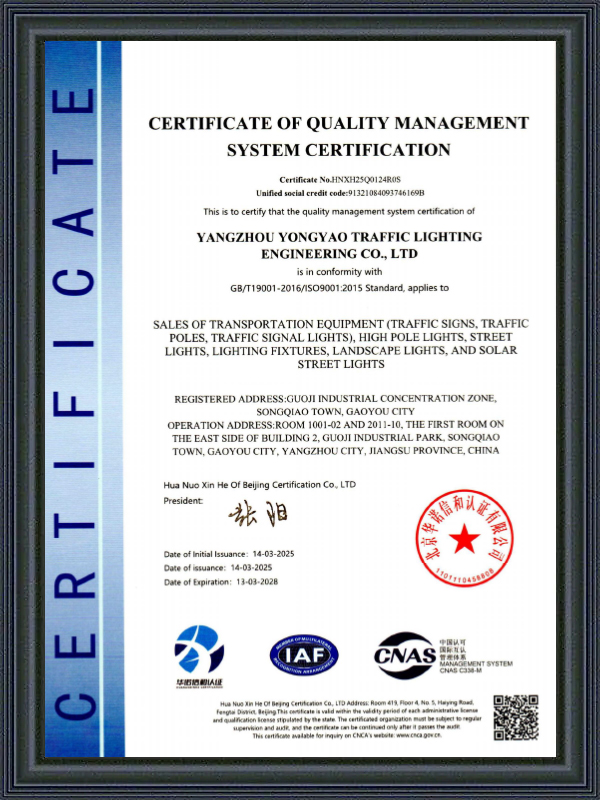
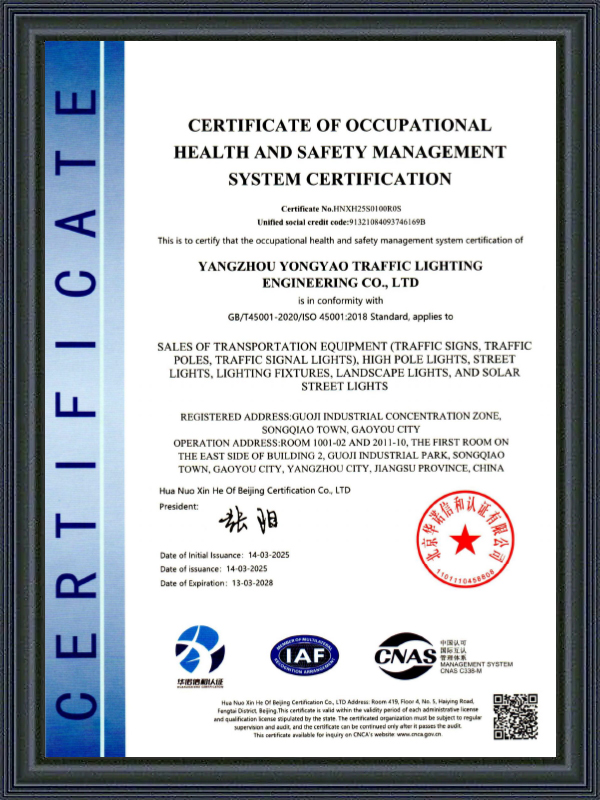
Production follows confirmed specifications with inspections at material, fabrication, coating and assembly stages. We maintain quality management system certification and environmental and occupational health and safety management system certification for our manufacturing operations.
Acceptance criteria are agreed with the customer before production. Typical checks include structural dimensions, weld quality, galvanizing thickness, coating adhesion, signal head function, controller operation and battery voltage. We can prepare inspection records and product documentation to support project handover.
Installation, Maintenance and Serviceability
Solar signal lights are installed on prepared foundations with the panel oriented for maximum solar exposure. The battery bank is typically housed in a waterproof enclosure at the pole base or in an underground battery box. Installation must avoid shading from buildings and trees throughout the day.
- Panel cleaning: regular cleaning maintains photoelectric conversion efficiency.
- Battery inspection: check charge controller status and battery voltage during scheduled maintenance.
- Signal head check: verify LED operation and lens condition after severe weather.
- Spare parts: replacement panels, controllers, batteries and LED modules can be supplied with project orders.
We provide installation guidance and documentation covering foundation requirements, wiring connections and controller settings. For projects with multiple intersections, we can supply consistent component sets to simplify spare parts stocking.
Information We Use to Configure Your Solution
To prepare a suitable solar signal light proposal, we need the following project inputs. These allow us to confirm the technical configuration, quantity and delivery scope.
- Site location and latitude for solar sizing
- Intersection layout, lane width and required signal head positions
- Number of signal heads, lens size and display type
- Required days of autonomy during overcast weather
- Pole height, arm length and foundation drawing if available
- Control requirements: wireless synchronization, flashing mode, interface with existing controller
- Environmental conditions: wind load, temperature range, coastal or dusty exposure
- Quantity, delivery schedule and destination port
With these inputs, we confirm the solar panel and battery capacity, structural dimensions and control configuration, then provide a quotation and production schedule.
Frequently Asked Questions
How many days can a solar signal light operate without sunlight?
Our battery banks are typically sized for 72–100 hours of continuous operation during overcast or rainy weather, depending on the configured capacity and signal load. We confirm the autonomy requirement during project review.
Can the solar signal light be synchronized with other intersections?
Yes. We offer wireless synchronization and wired networking options so multiple signal heads can switch together. The control method is confirmed against the project's traffic management scheme.
What pole and foundation information do you need?
We need the pole height, arm length, signal head load and local wind speed requirement. If a foundation drawing is available, we review it to confirm base plate and anchor bolt compatibility.
Do you supply solar signal lights with custom signal sequences?
Yes. The charge controller and signal controller can be configured for specific flashing modes, timing plans or interface requirements. We confirm the sequence logic before production.
What documentation is provided with a solar signal light order?
Orders include product specifications, installation guidance and inspection records. Certificates for quality, environmental and occupational health and safety management systems are available for project documentation.
Can you supply solar signal lights as part of a larger road project package?
Yes. We manufacture solar signal lights alongside traffic signal poles, road signs, monitoring poles and lighting poles. Coordinating these items in one order simplifies logistics and interface confirmation. See our Products range for related structures.
Yongyao provides customized traffic signal products for different road infrastructure projects.
We support adjustments in structure, dimensions, installation methods, and equipment compatibility to meet specific project requirements.

Yongyao is ready to support your project with responsive communication and practical, project-oriented product solutions.
-
 18052558887@163.com
-
913041567@qq.com
-
 +86-18052558887
-
 Zone 3, Guoji Industrial Park, Songqiao Town, northern suburbs of Yangzhou, Jiangsu Province, China
Copyright © 2026 by Yangzhou Yongyao Traffic Lighting Co., Ltd.
